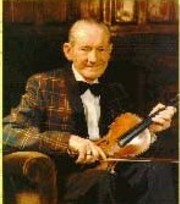
 Angus Fitchet, of Dundee, was one of Scotland's foremost fiddlers and bandleaders. He was also a remarkably versatile musician whose experience ranged from village dances to network television shows accompanying high profile international guest artists. Check out The Music of Angus Fitchet vol 1 and Volume 2 in our book store and The Legendary Angus Fitchet CD
Angus's father worked on a small dairy farm outside Dundee and Angus recalled being wakened in the morning to the sound of his father's fiddle. He was understood to be a fine player and had been taught by John Lamond of Monikie. It wasn't long before he uprooted the family and settled in Dundee where he hoped to make a better living. It was he who gave young Angus his first lessons when he was five years old and before he was very much older, Angus was playing at dances alongside his father. When he got tired, he lay down at the back of the hall and slept for a while before taking his place once more in the band, quite often playing until 2.00am! He went to various teachers but seems to have gained his considerable musical knowledge from watching and listening and from natural ability.
In the days before 'talkies', the cinemas hired small orchestras to add musical drama to the films being shown. In the street where Angus lived, these musicians used to congregate on a Sunday afternoon for a "session". Angus was right in there, handing out music, running errands, listening, watching, discovering the joys of classical music, hearing for the first time of Haifitz and Kreisler, borrowing records and playing them slowly until he could play along with them. He would play scales and arpeggios for hours (something he continued to do even when he was quite an old man), and then, at the ripe old age of twelve, a visiting piano tuner heard him and asked if he could play one night at the local cinema as the violinist was absent.
This was the beginning of Angus' professional musical career. And what a different way of life this was compared to that of a professional musician in the latter half of the 20th century. On a Monday morning the film would be shown and the conductor would decide what music would be most appropriate - romantic music for love scenes, short excerpts from the classics for chases, cowboy sequences, etc. Then came the advance publicity for the big feature film, "Uncle Tom's Cabin" - and the musical score was sent with the film! - orchestra parts for an orchestra of 120 - and only three musicians in Dundee's "Britannia" Cinema! Angus recalled that often the musicians could not hear themselves because of the audience discussing with each other what was happening - "silent" films indeed! But what a wonderful experience for a young lad - and his five shillings per week helped the family finances. This, however, came to a sudden end with the advent of 'the talkies'.
Angus, however, did not plan to give up his musical career. He bought a saxophone and was soon playing this instrument very competently. Angus first married in 1932 and had three children by the late 1930's, when he went to Largs to join a five-piece orchestra in a restaurant there. This engagement came to an end during the early years of the war when the Italian family who owned the restaurant was interned for the duration. The family returned to Dundee where, in 1945, Angus joined Jimmy Shand’s Band. Three years later, Angus married Bette. This was a loving partnership, which produced two more children.
Working with Jimmy Shand's Band gave him a taste for Scottish band work and he later formed his own highly successful Scottish Dance Band - but what other band leader drove his band all over Scotland and England in an old Dodge Red Cross ambulance which had cost him £50 and was run on half petrol and half paraffin? "Sometimes we couldn't see for the smoke!" There was the famous occasion when, at North Queensferry, the boat had moved off but when it was noticed that an ambulance had been left behind, the ferry turned back and Angus cheerfully drove his "band bus" on board. Inside, the members of the band were sitting playing dominoes! The opening of the Forth Road Bridge made life much easier! The Band played many live broadcasts, made records, and toured Scotland and England, playing in village halls and at large Scottish Country Dances. And many times Angus would write the date and place of a new booking on a cigarette packet then, cigarettes finished, toss the packet out of the bus window!" With his legs invariably crossed, his small frame curled lovingly round his instrument, Angus never played a wrong note. One night when playing for a "Dashing White Sergeant", he suggested that he and the two accordionists in the band take turns choosing the tunes. Jimmy Stephen led with "The Rose Tree", followed by the second accordionist's choice of "The Mason's Apron". When it was Angus's turn, with an irrepressible grin, he went straight in to "The Spey in Spate"; one of the most difficult reels ever written. He then laid his fiddle down, folded his arms and sat back to watch the band furiously trying to get their fingers round this tune!
For some years Angus gave up his band and returned to playing solo fiddle, touring with the well-known Scottish artists, Will Starr and Robert Wilson. The sweet tone Angus brought out of the fiddle was always recognisable, no matter which band he was playing in. He did not have valuable fiddles but could coax the same tone out of whatever instrument he played. When asked once by a so-called expert "What make of fiddle are you playing, Mr Fitchet?” Angus replied in his broad Dundee accent, "Eeh, it's just an auld bit o' stick". He was very happy with a fiddle he bought for £5 in a market in Dundee but always insisted that a fiddler needs a good bow, preferably a Viom or a Turte.
He was in his late sixties when he joined Jimmy Blue, whose band travelled full time with Andy Stewart and this was a wonderful partnership. Andy loved Angus' humour and many a time "dried up" onstage because of Angus' witticisms. On one occasion an English pop group guesting on the show was having great difficulty in their rehearsal, due to some bars having been missed from their orchestration. As the afternoon dragged on and the band waited for its run-through, Angus finally shouted to the group "Div ye no' ken Danny Boy?" Andy Stewart's weekly TV show, "Scotch Corner", was going out nation-wide at that time with guest stars such as George Hamilton IV, Rolf Harris, Dana, Julie Felix and others. Angus loved the challenge of sight-reading the "dots" placed in front of him and enjoyed the tours to Australia and New Zealand with the show where, on one wet Saturday, he exhibited his prowess with a different kind of stick when he entertained the cast of the show with a repertoire of most impressive tricks on the snooker table!
Having overcome deafness and a severe bout of arthritis when he was no longer able to play his beloved fiddle, Angus found relief with a course of 'gold' injections. All were delighted when he was once again able to draw the bow across the strings and produce his unique sound.
With the advent of Accordion and Fiddle Clubs, Angus found yet another new career, guesting with Bobby Crowe and his Band at venues all over Scotland and in the North of England. There is a wonderful memory of him at Banchory Club where he had finished his guest spot and invited all the young members of the Banchory Strathspey and Reel Society to join him on stage. Angus sat on the front of the stage, legs dangling over the edge, and played along with the youngsters giving them wonderful encouragement as well as a night to remember. Angus, however, did not just make guest appearances. He was a regular at Dundee Accordion Club where he often spent more time in the back room giving tips to young fiddlers who listened and learned
.
To travel to 'gigs' with Angus was a delight. Every village brought a memorable story to relate which would digress into tales of characters he had met or tunes he had played and always there was humour and laughter. Reminiscing about Angus is to remember always, his gift of fun, his sometimes quite wicked sense of humour. Jim Brogan, who was a member of his band for many years, recalled one occasion when, driving home in the early hours of the morning, Angus slowed down coming into Stonehaven, looking to right and left. The same thing happened as they entered Montrose and suddenly Angus stopped the bus, dashed out and ran back the way they had come. The band sat still, wondering what could have happened. Suddenly Angus jumped back into the driving seat, clutching a bunch of beautiful red roses wrapped in a handkerchief. "Where did you get these at this time of night?" "Och, there's a garden full of them back there - they'll never miss them". "Is it your wife's birthday?" he was asked. "No, the family is going to a wedding tomorrow and we need buttonholes". He was eternally young at heart.
When he was in his 80th year, the BBC did a two-band broadcast from the annual weekend gathering of the National Association of Accordion and Fiddle Clubs, recorded in a hotel in Perth. Robbie Shepherd was unable to link the programme and the bandleaders were asked if they would be able to make their own introductions. Angus not only introduced members of his band and announced the tunes, but went on to introduce the "Club News", which followed the Scottish Dance Music! And all done with the utmost confidence and professionalism. Probably his last appearance at a Club was in Perth, when he was 81 years of age.
But Angus's legend will live on in his music. He was a prolific and wonderful composer who wrote his first tune, "Mr Michie", in1926 - a march, which is still popular with Festival competitors. His reel, "J.B. Milne", has probably been broadcast more than any other Scottish tune. But his slow airs, such as 'Happy Retirement', 'Marjorie Jane Barclay', and 'Lament for Will Starr', like his many other compositions, make him comparable to the great James Scott Skinner. When the news broke of the tragic Lockerbie air disaster, it was suggested Angus write a "Lament for Lockerbie". Two days later, the manuscript of this moving slow air was delivered by Angus. Very few people know that he also wrote some words to suit the music which, he thought, could be sung as a hymn! When Bobby Crowe played his newly composed march "The Provost of Forgandenny" over the telephone to Angus, he was amazed to receive next day, in the mail, another march complementary to his tune in both idiom and key -although Angus had not even enquired in which key the original had been written. He was also an innovator. In the fifties and sixties, the BBC demanded simple chords be played and anything so contemporary as a diminished 7th was not permitted. Angus got round this by writing a diminished sequence into "J.B. Milne", so that the chord could not be dispensed with!
When asked, in his eighties, how he would like to be remembered, Angus considered for a few moments, then replied: "Angus Fitchet, fiddler". He will certainly be remembered as a fiddler of considerable note. But it is for his wonderful and prolific compositions that Angus Fitchet's name will live on in the history of Scottish music.
Check out The Music of Angus Fitchet vol 1 and Volume 2 in our book store.
ON ANGUS FITCHET
by Andy Stewart
Come rub the rosin on the bow
And let the warl' gae roon'
Whiles I tae Angus Fitchet heed
That coaxes up a tune,
That coaxes up a bonnie tune
An' maks yon fiddle sing,
The verra lame when he begins
Wad dance the heilan' fling.
Syne when ablow his elfin chin
The trusty Hardy grips
The Merlin o' the music, he,
Wi' magic fingertips.
The shades of Skinner and of Gow
Wham nane shall e'er neglect,
I fancy tap their toes in time
And nod their grave respect.
Strathspeys sae stately and demure
Come singing frae his hand,
While jigs and reels, however gleg,
Dance out at his command.
Sae blythe and sweet his fiddle sings
And brawly fills the air,
His smiles and looks tell a' the tale,
A lang-matched love affair.
Wha' is sae heavy-fitted then
An' weary as the Deil
But loups like ony skippin' lamb
When Fitchet plays a reel?
An wha' can keep frae beatin' time?
I say he isna human,
When Angus plies his skill upon
"The Irish Washerwoman"?
(In Cork one night, I tell the truth,
He caused a fightin' fuss
When Paddy said "Yon man's no Scot,
He must be one of us")
He plays a jig sae liltin' sir,
A man condemned tae dee
Wad loup the thirteen steps an' dance
Upon a gallow's tree.
An' fan a sweet sad bow he draws
In some auld plaintive air,
The sorrows o' a lifetime come
An' stoun' the senses there.
"Bovaglie's Plaid" or "Gow's "Lament",
Baith hymns tae mak us mourn
Great sabs frae oot yet greater hearts
For joys will ne'er return.
In black and white these printer notes
Lie lost of what they seek,
Yet cry aloud in haunting sound
When Angus maks them speak.
Auld Scotland kens nae brawer tunes,
And min' she maks them well,
Than when oor Angus plays tae her
The yins he wrote himsel'.
His repertoire's an endless dance
And were he ay sae clever
As nae need food or drink or sleep
He could play on forever
Here's tae him then my prayer shall be
That happy he may dwell
And a' the wishes I wad gie
That he could wish himself
Three score and more - I ken his age -
An' Lord if it's nae trouble,
In years tae come - Ye ken the sum -
I wish him,mair than double
An' when at last at Heaven's gate
Whaur he will surely stand
I like to fancy Peter say
As he hauds oot his hand -
"A welcome Angus Fitchet here
My pleasure is to gie ye,
An twice that welcome since I see
Ye've brocht your fiddle wi ye.
But och, there's years o' music yet
Tae stir the dancers roon,
Sae Angus rosin up your bow
An gie's another tune.
The hame-spun garb o' native worth
Wi' cloth of gold we'll stitch it
And lay the makkar's mantle on
This man ca'd Angus Fitchet.
When he comes ben care hugs the wa'
An' joy jinks in the middle
The doul's awa, the dance is a',
When Fitchet plays his fiddle
Mak a' his 'oors be sweet and sure
And happy a' his days,
As happy as I am myself
When Angus Fitchet plays.
This article on Angus Fitchet appears courtesy of the National Association of Accordion and Fiddle Clubs and Foot Stompin' Celtic Music are grateful to the Association for permitting us to reproduce it on this website.
| 












 |
|